PUERTO RICO
Fuerte del Abanico |
Advanced Defense Line |
Aguadilla Barracks |
Aguadilla Res. |
Fort Allen
Fort Amezquita |
Batería de Añasco |
El Arsenal de la Marina |
Batería de Baja Mar
Ballajá Barracks |
Borinquen Field |
Fort Brooke |
Camp Buchanan |
Fort Buchanan
Fort Charles Bundy |
Batería de Cabo Rojo |
Cabo Rojo Fort |
Cabras Island Res.
Fuerte El Cañuelo |
Caparra |
Fort Capron |
Casa Blanca |
Fuerte de Castro
Coamo Blockhouse |
Fortín Conde de Mirasol |
Fuerte de la Concepción
Culebra Island Batteries |
Daguao |
Fort Elizabeth |
Camp Ensenada
Batería del Escambrón |
Escambrón Defense Line |
Fortin del Espigón |
Fortín de Fajardo
Camp Garcia |
Fortín de Guayanilla |
Henry Barracks |
Camp Henry |
Higuey
Bastión Isabel II |
Fortín Isabel II |
Camp James |
Camp Las Casas
Las Líneas de Defensa de San Juan |
Camp Losey |
Fort Mascaro |
Fortín de Mayagüez
Mayagüez Res. |
Camp Miles |
Batería de Miraflores |
Miraflores Powderhouse
Fuerte del Morrillo |
El Morro Castle |
Fort Mosquetal |
Camp O'Reilly
Batería de Patillas |
Fortín de Pedernales |
Batería de Peñuelas |
Fuerte de la Perla
Fortín de la Playa de Ponce |
Ponce Barracks |
Ponce Res. |
Fuerte Princesa
Batería de Puerto Real |
Batería del Puerto |
Punta Cangrejos Res. |
Punta Escambrón Res.
Punta Figuras Firing Range |
Punta Salinas Res. |
La Real Fortaleza |
Fuerte San Antonio
Fuerte (Battería) de San Carlos |
Castillo de San Cristóbal |
Castillo de San Felipe del Morro
Batería de San Fernando |
Batería de San Francisco de Paula |
Fortín de San Germán
Fuerte San Gerónimo de Boquerón |
San Gerónimo Powderhouse |
Batería de San José
Fuerte San Juan de la Cruz |
San Juan Military Res. |
Old San Juan Defenses
Fortín de San Miguel Arcangel |
San Ramón Barracks |
Batería de San Ramón
San Sebastian Powderhouse |
Santa Catalina Palace |
Santa Elena Powderhouse
Santa Isabel Field |
Fuerte Santa Teresa |
Batería de Santo Toribio |
Camp Salinas
Salinas Field |
Camp Santiago |
Torrecilla |
Camp Tortuguero |
Vega Baja Field
Vieques Island Batteries |
Camp Wainwright |
Fortín de Yauco
WWII Air Defense Radar Stations
(NOT INDEXED)
THE SPANISH-AMERICAN WAR IN PUERTO RICO
THE SPANISH-AMERICAN WAR IN PUERTO RICO (en Español)
WELCOME TO PUERTO RICO
Fortín de Pedernales

(unknown dates), Cabo Rojo
A Spanish colonial fortification built before 1828, when it was repaired. Also known as Batería de Cabo Rojo.
Fortín de Mayagüez

(1775 ? - unknown), Mayagüez
A Spanish colonial fortification at Boca Morena. Also known as Batería del Puerto. It was built sometime before the 1821 slave revolt in nearby Bayamón. The Powderhouse was built in 1825. It was reported destroyed in the 1918 earthquake and tsunami. No remains. The town was founded in 1760.
¤ TEMPORARY HARBOR DEFENSES of MAYAGÜEZ 
¤ Mayagüez Military Reservation
(1941 - 1946), near Mayagüez
Battery Algarrobo, a four-gun 155mm battery on Panama mounts, was located about three miles northwest from the city, near Punta Algarrobo. Site condition unknown, probably destroyed.
Higuey

(1506 - unknown), near Añasco
The short-lived Casa Fuerte del Higuey was built here in 1506, the first known Spanish fortification in Puerto Rico.
Fortín de San Germán
(1529 ? - unknown), Añasco
The old town was founded in 1511. A fort was ordered built in 1514, but was probably not begun until 1529, after the French had sacked the town in 1528.
(NOTE: The present town of San Germán was founded/relocated in 1573.
Batería de Añasco
(1826 - unknown), Añasco
A Spanish colonial fortification. No remains.
Fuerte de la Concepción
(1823 - unknown), Aguadilla
A Spanish colonial fortification. Attacked in 1825 by Colombian privateers. By 1890 it was used as a local police barracks. The town was founded in 1775.
Fuerte (or Batería) de San Carlos was previously here when the British attacked the town in 1797.
Aguadilla Barracks
(1903 - 1921), Aguadilla
A U.S. Army garrison post until transferred to the local defense force. This was probably the police barracks, the former Fuerte de la Concepción.
(thanks to Marshall Sitrin for additional info)
¤¤ TEMPORARY HARBOR DEFENSES of AGUADILLA
¤¤ Aguadilla Military Reservation
(1941 - 1946), near Aguada
Battery Aguada, a four-gun 155mm battery on Panama mounts, was actually located about 4.5 miles southwest from Aguadilla. At least one concrete mount still exists, located on Playa Cañones near the town of Aguada. The battery site is currently owned by the Puerto Rico Dept. of Natural Resources.
Borinquen Field
(Ramey Air Force Base Historical Association)
(1939 - 1973), Borinquen
A U.S. Army Air Corps airfield. Battery Borinquen, actualy two two-gun 155mm batteries on Panama mounts, was located here in 1941, site of the east battery now a dedicated WWII memorial (2014) at the U.S. Coast Guard Borinquen Air Station. The west battery was located on the former military 9-hole golf course (now the public Punta Borinquen Golf and Country Club). Several 3-inch AA, and 105mm and 75mm field guns, were also located here. The airbase later became Ramey Air Force Base in 1948. Now the Rafael Hernández International Airport. It has the longest runway in the Caribbean region (11,700 feet).
Fortín de San Miguel Arcangel
(1770 ? - unknown), Arecibo
A Spanish colonial fortification, built after a British naval attack of the town in 1702. Rebuilt/enlarged in 1813. Destroyed in 1881, site now Paseo de Damas. The Powder House still partially exists, now derelict and in ruin (2010) adjacent to a parking lot. The town was founded in 1606.
Camp Tortuguero
(1941 - 1947/1980), near Vega Baja
A Puerto Rico National Guard training camp, used by the 295th and 296th Infantry Regiments. The US government acquired the site, located northeast of Lake Tortuguero and contiguous to the Atlantic Ocean, in 1941 for use as a small arms firing range. When the Army no longer needed the site, the use of the range was licensed to the Puerto Rican National Guard between 1947 and 1976, and it was used as a small arms firing range. The lease was terminated in 1980, and the property was transferred to the Puerto Rico Land Authority, in lieu of restoration. The 107-acre site is five miles northwest of town. The property is now privately-owned and has been fully developed.
The Vega Baja Auxiliary Field (1941 - 1956) was built by the U.S. Army Air Corps. The site was used by the PR National Guard from 1956 until 1975 for training purposes.
Fuerte de Castro
(1797 - unknown), near Toa Baja
A Spanish colonial fort was once located at Punta Salinas on what was then known as Isla Batería. The ruins were still evident in 1937, but were finally destroyed by the U.S. Army in 1941 to build Fort Mascaro.
¤ COLONIAL FORTS of OLD SAN JUAN
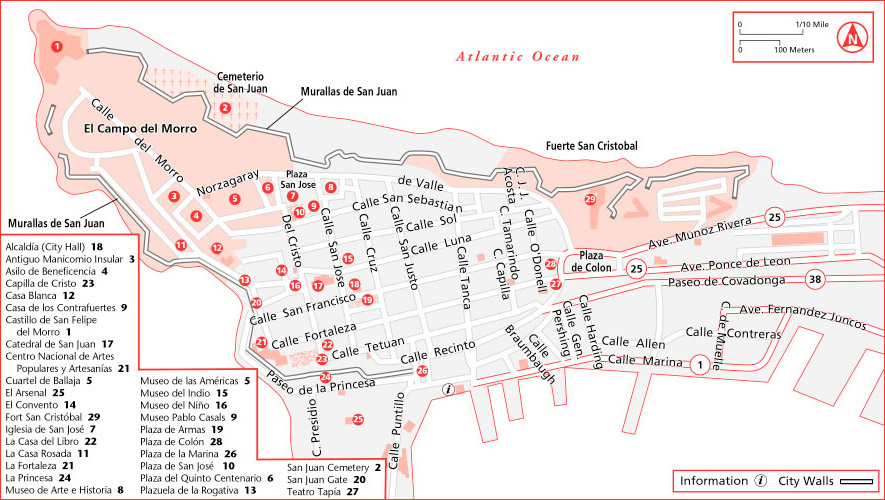
Map of Old San Juan Attractions
¤ Fuerte El Cañuelo
(San Juan National Historic Site)
(1610 - 1625, 1670's - 1900 ?), Isla de Cañuelo
This fort at the entrance to San Juan Harbor was originally a wooden structure which was destroyed by the Dutch in 1625. The present structure, Fuerte San Juan de la Cruz, was built of stone in the 1670's. The original islet was later connected to the larger nearby Isla de Cabras by a rock causeway in 1935. Public access to the old fort's interior is currently restricted.
¤ El Morro Castle

(San Juan National Historic Site) 
(1539 - 1961), Old San Juan
Castillo de San Felipe del Morro towers 140 feet above the sea. It is a six-level maze of tunnels, dungeons, barracks, outposts and ramps covering 200 acres. Admission fee. Attacked by the English under Francis Drake in 1595 but repulsed. The fort was captured only once - by land, in 1598 by the English and held for three months. Attacked by the Dutch in 1625 but repulsed again, although the city itself was sacked. Most of the present fortifications were built between 1587 and the 1650's. The original fort was a large square tower with a circular gun battery at the water, completed in the 1580's, although its first guns were installed in the 1550's. The original Hornwork was constructed in 1589, with two half-bastions (Tejada/Ochoa and Austria) and a ravelin. The "V"-shaped Santa Bárbara Battery comprises the third level of the fortress above and behind the old Water Battery. The Carmen Battery is on the fourth level facing the sea. The small Texada Battery faces the sea below Carmen Battery. The Santa Elena Battery, built in 1586, was located outside the Hornwork, between it and Casa Blanca. The Santa Elena Powderhouse (1783) is also located here. The last improvements to the fortress were made in 1790.
The old fortress was later a component of Fort Brooke (see listing below). In WWI the U.S. Army had emplaced two 4.7-inch Armstrong guns here, one mounted on the Santa Bárbara Battery, and the other mounted on the Santa Elena Battery. Both guns were scrapped in 1919. In WWII one 3-inch gun was emplaced on the old Armstrong mount at Santa Bárbara (Battery Point), and a HECP and three artillery fire-control stations were built on the outer walls of the main fortress, above the Carmen Battery.
¤ City Walls of Old San Juan (Las Murallas)
(San Juan National Historic Site)
(1634), Old San Juan
Construction began in 1634 after the Dutch sacked the city in 1625. It was essentially completed between 1638 and 1650, but minor work continued until 1678. The wall is composed of two 42-foot high parallel sandstone walls with the space between filled with sand. It surrounds and fortifies the old city and once included six gates, the last one remaining is San Juan Gate (1635) near La Fortaleza. Some of the wall was dynamited near San Cristóbal Castle to allow the city to expand in the 1890's. Portions of the wall have disintegrated due to erosion (hurricanes) and poor maintenance over the years. Encyclopedia of Puerto Rico entry #1 || Encyclopedia of Puerto Rico entry #2
Named bastions (baluartes) located along the perimeter of the walls are/were known as (clockwise from El Morro to San Cristóbal): San Antonio (1742); Santa Rosa (1776); Santo Domingo (1778); Las Animas (1778); Santo Tomás (1780); San Sebastian (1780); Santiago (1639) (destroyed 1897); San Pedro (1639) (destroyed 1897); San Justo (Left / Izquierda) (1639) (destroyed 1897); San Justo (Right / Derecha) (1636); Las Palmas (1635); La Concepción (1640); Santa Catalina (1640); San Agustín (1640); Santa Elena (1590, 1635, 1778); and San Fernando (1742). Outside the wall between the Santiago and San Pedro bastions was the Batería de San Francisco de Paula (1796) (destroyed 1897). The former gates (puertas) were known as: Santa Rosa (1870) (between the Santa Rosa and Santo Domingo bastions); San Jose (1877) (at the Santo Tomás bastion); Santiago (1639) (at the Santiago bastion) (destroyed 1897); San Rafael (1874) (between the San Pedro and San Justo (Left) bastions) (destroyed 1895); and San Justo (1639) (between the two San Justo bastions) (destroyed 1894).
Detached powder magazines (polvorins) within the walled city were: Santa Elena (1783) (behind the Santa Elena bastion) (still extant, administered by the NPS); and San Sebastian (1791) (behind the San Sebastian bastion) (abandoned 1880, later destroyed to build the Abraham Lincoln Public School).
Before the completion of the walls, Fuerte del Morrillo (1600's ?) was once located at or near where the Santa Rosa bastion is now located. Fuerte de la Perla (1600's ?, rebuilt 1776-92, demolished 1867) was once located between the Las Animas and Santo Tomás bastions, in the present-day La Perla community.
¤ La Real Fortaleza
(1533 - 1846), Old San Juan
Also known as the Palacio de Santa Catalina, part of this mansion was originally built as a defense against native Indians, which consisted of a medievel-style castle with a round tower. It was originally completed in 1540. A second tower (Austral Tower) was built in the 1590's. The rest of the structure was built in 1846 to serve as the governor's palace. It is the oldest executive mansion in the Western Hemisphere still in use. The fort was captured by the English in 1598, and burned the Dutch in 1625 when they failed to take El Morro Castle. The island's governor (Captain-General) has typically lived here since 1640. The original tower, Torre del Homenaje, still stands, so named for the tradition of the resident governor to climb to the top to pledge a solemn oath of loyalty and courage during dangerous times. Partial public access during group tours.
¤ Casa Blanca (Museum)
(1523, 1779 - 1966), Old San Juan
The "White House" was a square stronghouse (casa fuerte), originally the home of the family and decendants of Juan Ponce de Léon, the island's first governor. Since 1779 this building has been the residence of the commanding generals of both the Spanish and the American militaries. It was used as the Governor's Mansion after WWII. In 1967 became a house museum operated by the Institute of Puerto Rican Culture. Admission fee.
¤ El Arsenal de la Marina
(1791 - 1911), Old San Juan
Originally built by the Spanish Navy. Masonry construction replaced temporary wooden buildings in 1800. Later became a defensive citadel for the naval base. This was the last Spanish post in the city that was captured by the U.S. Army in 1898. It is now a museum and cultural center.
Nearby at La Puntilla was once located Batería de Santo Toribio (1826-1883). No remains. Earlier gun batteries were also located here in 1625 and 1797.
¤ Cuartel de Ballajá
(1854 - 1943/1976), Old San Juan
The Ballajá Barracks were originally built as Spanish infantry barracks for 1000 men to ease overcrowding at the forts. It is a three-story square building with large gates on two ends, ample balconies, designed with a series of arches and a protected central courtyard that served as a plaza and covers a reservoir. Facilities included Officers' quarters, warehouses, kitchens, dining rooms, prison cells and stables. After the Spanish-American War, the U.S. Army used Ballajá to house its infantry division. In 1943 it was converted into a military medical facility, known as the Rodriguez Army Hospital, part of Fort Brooke. Today it is used by the University of Puerto Rico, and it also houses the Museum of the Americas (opened October 12, 1992) on the second floor, as well as other organizations.
¤ San Cristóbal Castle
(San Juan National Historic Site)
(1634 - 1961), Old San Juan
Castillo de San Cristóbal rises 150 feet above the sea and features five separate units covering 27 acres. Admission fee. Although connected by moats and tunnels, each unit is self-sufficient in case any of the others should fall to the enemy. Earlier fortifications were located here in 1625. Originally built as a small redoubt with adjoining earthen ramparts, known as Fortin del Espigón. The so-called "La Garita del Diablo" (the Devil's Sentry Box) may be a remnant of this early work. Substantially rebuilt in 1765, completed by 1783 as the second largest Spanish fortress in North America. Its main purpose was to defend the town from land attacks from the east. Its main section was a hornwork that essentially continues the walls surrounding the city. The highest part of San Cristóbal was the Caballero (Cavalier), a large gun platform on top of the hornwork. In front of (in advance of) the hornwork were three detached fortifications: the San Carlos and Santiago ravelins, and the Trinidad counterguard, surrounded by a dry moat. Beyond the moat was a sizable plaza de armas that led out to a strong fort whose arrow-shape led it to be called Fuerte del Abanico (the "Fan"). Seaward from El Abanico are Fuerte Santa Teresa, a redoubt aimed at the ocean, and Fuerte Princesa, whose guns could fire towards the sea and land. These outworks were later incorporated into the "Third Line of Defense" in 1794. The British attacked the city in 1797 but were repulsed at the "First Line of Defense" at Punta Escambrón (see below) to the east. This fort fired the first shot of the Spanish-American War in Puerto Rico. Spanish batteries active in 1898 were Battery Princesa and Battery Santa Teresa. Encyclopedia of Puerto Rico
The old fortress was later a component of Fort Brooke (see listing below). In WWI the American Army had emplaced one 4.7-inch Armstrong gun at Battery Princesa (scrapped in 1919). In WWII a 155mm gun battery on Panama mounts was later built on Battery Princesa, and two artillery fire-control towers were built on the outer walls of the main fortress, on the Cavalier Battery.
¤¤ Las Líneas de Defensa de San Juan
(1794 - 1898), San Juan
Three separate lines of earthen and/or masonry defensive curtain walls and trenches were constructed east of the walled fortifications of Old San Juan (in the Puerta de Tierra area), from the Atlantic shoreline to the San Antonio Canal, connecting and incorporating already established forts and batteries, to prevent or delay landward attacks on the city. The forts and batteries of the eastern "First Line of Defense" (aka La Línea de Avanzada) (1797) at Punta Escambrón (listed below) successfully withheld the British attack in April 1797. The walls of the "First Line" were demolished between 1908 and 1938. Ruins of some portions of the interior "Second Line" (1850's) and the western "Third Line" (1794) still exist. The masonry ruins of Batería de Baja Mar (1794) (3rd Line) still exist on the beach at Baja Mar. The masonry ruins of Bastión Isabel II (1797) (2nd Line) still exist at Calle San Agustín and Avenida Constitución. Encyclopedia of Puerto Rico
¤¤ Batería del Escambrón
(1771 - 1912), San Juan
A Spanish redoubt located at Punta Escambrón. Three guns were active here in 1898. A WWII steel-frame fire-control tower was built within the redoubt in 1942 (dismantled in the 1950's). The interior is not open to the public, although the grounds can be walked. Restored in 2003.
¤¤ Fuerte San Gerónimo de Boquerón (Historic Monument)
(1791 - 1797, 1799 - 1912), San Juan
Originally the site of a four-gun battery in 1609. Continuously rebuilt and enlarged throughout the 18th century. The British fleet attacked the city in 1797 with 60 ships and 3,900 troops, but were repulsed here. The severely damaged fort was rebuilt in 1799. The present structure is now a military history museum operated by the Institute of Puerto Rican Culture, located adjacent to the Caribe Hilton Hotel on Boquerón Beach, in the Puerta de Tierra area. In WWII Battery 263 was located nearby (see Fort Brooke listing below). Encyclopedia of Puerto Rico
Nearby was Batería de San Ramón (1779), once located on a small hill just to the northwest (destroyed in 1940 except for a single stone garita on the grounds of the Caribe Hilton Hotel). The Cuartel Defensivo de San Ramón was built here in 1898. No remains.
¤¤ Polvorin de San Gerónimo
(1769 - 1912), San Juan
The San Gerónimo Powderhouse was one of four brick and masonry magazines built by the Spanish. The rectangular building features a vaulted interior supported on both sides by ten massive buttresses. It was once connected to Fuerte San Gerónimo by a line of defensive trenchworks. In 1935 the former magazine was used as the Museum of Natural History, then became a zoo in 1945. It was restored in 1994 by the Puerto Rico National Parks Trust. Located within Luis Muñoz Rivera Park in the Puerta de Tierra area.
¤¤ Fuerte San Antonio
(1776 - 1894), San Juan
A small Spanish fort located southwest of Fort San Gerónimo, at the north-end of the San Antonio Bridge. Mostly destroyed by the construction of modern bridges after 1894. Still shown on 1898 battle maps. A small section of the remaining battery parapet was restored in 2012.
¤¤¤ HARBOR DEFENSES of SAN JUAN
¤¤¤ Fort Brooke
(1903 - 1949/1966), Old San Juan
This was the U.S. Army's main garrison post, centered mainly around the historic El Morro and San Cristóbal Castles. Originally known as the San Juan Military Reservation. Renamed in 1943. The Americans built a harbor entrance control post (HECP) and Battery Point (a three-inch gun mounted on an older 4.7-inch Armstrong gunblock) on the old El Morro fortress, as well as three fire-control stations (one still exists). Located at San Cristóbal Castle were two fire-control stations (still here), and a 155mm gun battery on Panama mounts. Numerous barracks and quarters covered the open plain below El Morro ("El Campo del Morro"). The old Ballajá Barracks became the Fort Brooke Army Hospital (aka Rodriguez Army Hospital) in 1943. The Convento de los Dominicos, originally built in 1523, was used in WWII as the administrative headquarters of Fort Brooke and the U.S. Army Caribbean (Antilles) Command. It is now a museum. Most of the historic areas of the post were nominally transferred to the NPS in 1949.
¤¤¤ Punta Escambrón Military Reservation
(1941 - 1949), Puerta de Tierra
Located here was Battery Schwan / 263 (1942 - 1949, destroyed 1965) at Punta Escambrón near Fort San Gerónimo. A hotel swimming pool is now on the site.
¤¤¤ Punta Cangrejos Military Reservation
(1941 - 1946), Boca de Cangrejos, near Loíza
Located here was Battery Lancaster / 264 (1942 - 1946) on Punta Cangrejos, north of the east-end of the runway at Luis Muñoz International Airport. The abandoned battery was later used as an aquarium from 1970 - 1975. The battery still remains, now overgrown in an area of private businesses and restaurants.
¤¤¤ Fort Amezquita
(1941 - 1948), Isla de Cabras
World War II batteries here were Battery Reed (1942 - 1948) (unnumbered 500-series battery) (two casemated 12-inch BC guns) (still exists); a 155mm Panama-mounted gun battery nearby; and an Anti Motor Torpedo Boat battery. A secondary harbor entrance control post (HECP) with an SCR-582 radar was also located here. Originally known as the Cabras Island Military Reservation until 1943. The two guns at Battery Reed originally came from Fort Delaware (Battery Torbert) in Delaware, and were emplaced on new barbette carriages. This site is now used as a local police training area and shooting range.
¤¤¤ Fort Mascaro
(1941 - 1948/present), Levittown, Toa Baja
World War II seacoast batteries here are Battery Buckey / 261 at Punta (Point) Salinas, and Battery Pence / 262 on East Salinas Island. Both still remain, built on by modern communications and radar installations (since 1964). Two fire-control towers were once located on Punta Salinas. Originally known as the Punta Salinas Military Reservation until 1943. The fort is now in use as a PR Air National Guard radar site. No public access.
¤¤¤ ALSO: Additional fire-control towers for the San Juan Defenses were once located at Vacia Talega, Punta Maldonado, Punta María (four), and Punta Escambrón, all east of Old San Juan. Those located west of Old San Juan were at Punta Fraile, and Punta Cerro Gordo. None remain. Battery Punta Cataño (AMTB) (1942 - 1943) was located in Cataño.
Polvorin de Miraflores
(1776 - 1912), Isla Grande, San Juan
A Spanish masonry powderhouse, protected by the nearby Batería de Miraflores (built before 1797). Used by the U.S. Navy after 1898. Overgrown ruins are located in the Miramar area, now encompassed by the Aeropuerto de Isla Grande.
Camp Las Casas
(1908 - 1946), San Juan
A training camp for the Puerto Rico Regiment of Infantry (later the U.S. Army 65th Infantry Regiment). Located in the Santurce area. Became a public housing project in 1950.
Torrecilla
(1520's), Boca de Cangrejos
The short-lived Casa Fuerte de la Torrecilla was located here.
Caparra (Archaeological Site)
(1508 - 1521), Caparra
The site of the first permanent European settlement on San Juan Island, known as La Ciudad de Puerto Rico. The foundation ruins of the Casa Fuerte de Caparra (1509) are located here, built by Juan Ponce de León, the first governor of the colony. The town and capital was abandoned for San Juan due to poor defense against the native Indians. Sometime later (1746 ?) the names for the city and the island were switched. Public access to the site is allowed. Nearby is the Museum of the Conquest and Colonization of Puerto Rico. Located on PR 2 at km marker 6.3 near Guaynabo. Encyclopedia of Puerto Rico
Fort Buchanan (U.S. Military Reservation)
(1923 - 2003/present), Bayamón
Originally known as Camp Miles until 1926. Redesignated a fort in 1940. Permanent structures built in WWII. It was the main garrison post of the U.S. Army's Antilles (Caribbean) Command after WWII, until 1966. The post was then under U.S. Navy control from 1966 to 1971. Became the headquarters post of the U.S. Army Southern Command (transferred from Panama) from 1998 to 2002. Still in use by the Army Reserve.
The Army first acquired property to construct Fort Buchanan in 1925. It was initially used for target ranges, but as war efforts expanded (including World War II and the Korean Conflict), additional land was obtained to accommodate additional activities. Fort Buchanan reached 1,818.54 acres and housed a general depot, an induction center, and a training center. Following World War II, the post provided administrative support for all technical service within the Antilles Command, the Army Terminal for Water Transportation, the US Army Personnel Center and the US Army Training Center, Caribbean. When the 65th Infantry Regiment returned from Europe, the first battalion was moved to Fort Buchanan. By 1949 Fort Buchanan’s military port and general depot received and shipped commodities for all of the Army and Air Command Stations in the Caribbean. In 1945 the Army began terminating leases and disposing of excess land through the General Services Administration, eventually shedding 1,037.44 acres. The remaining land houses the still active post.
Camp O'Reilly
(1942 - 1945), near Gurabo
A WWII training camp for the PR National Guard.
Fortín de Fajardo
(1819 - unknown), Fajardo
A Spanish colonial fortification. Also known as Batería de Puerto Real. Probably built to control local smuggling that was widespread between Puerto Rico and other nearby islands. Still reported in use in 1830.
¤¤¤ HARBOR DEFENSES of ROOSEVELT ROADS and VIEQUES SOUND (partial)
(see also Fort Segarra, USVI)
¤¤¤ Fort Charles W. Bundy
(1943 - 1947/2004, 2011 - present), Ensenada Honda, near Ceiba
Originally named Camp Ensenada (1943), renamed in 1944. World War II seacoast defense batteries on the mainland planned but not built were Battery 152 at Punta Mata Redonda, Battery 155 at Punta Yeguas, Battery 311 at Cabo (Cape) San Juan, and a second Anti Motor Torpedo Boat Battery.
Batteries that WERE built included Battery 406 (1943 - 1947) (two 8-inch naval guns) at Punta Mata Redonda (emplacements built, but the magazine was not, battery now overgrown); Battery 265, with an SCR-296 radar, on Isla Piñeros; Battery 268 (1943 - 1947, never armed) at Punta Lima (site now a prison); a two-gun 155mm Panama mounted gun battery at Punta Yeguas; and an Anti Motor Torpedo Boat Battery (90mm) and harbor entrance control post (with SCR-582 radar) at Punta Algodones.
The Roosevelt Roads Naval Operating Base was established in 1943, intended to be the major American naval base in the Caribbean region (the Atlantic's "Pearl Harbor"). Construction was suspended in 1944. The former Army post became the southern section of the Naval Station when it was reactivated in 1957. The Naval Base closed in 2004. The area is slated for future commercial development. The former Ofstie Air Field is now (since 2008) the José Aponte de la Torre International Airport. A portion of the former Fort Bundy post was reactivated in 2011 as the Puerto Rico U.S. Army Reserve Center, used by the U.S. Army Reserve and Puerto Rico National Guard. See also Roosevelt Roads Redevelopment Project
¤¤¤ Vieques Island Batteries
(1943), Vieques Island
The following World War II seacoast defenses were planned for Vieques Island but never built: Battery 153 on Mt. Pirata, Battery 154 at Cerro Matias Jalobre, Battery 266 at Cerro Martineau or Punta Mulas, Battery 267 at Punta Arenas or Mt. Pirata, and Battery 285 on East Point (Punta Este). Most of Vieques Island became a U.S. Navy/Marine base and a gunnery and bombing range in 1940 (renamed MCAS Camp Garcia in 1959), which was closed down in 2003 after public protests.
¤¤¤ Culebra Island Batteries
(1943), Culebra Island
These World War II seacoast defenses were planned but never built - Battery 312 at North Point, and Battery 313 at Dolphin Head. Culebra Island became a U.S. Navy gunnery and bombing range in 1940, which was closed down in 1975.
¤¤¤ ALSO: Coast Artillery fire-control towers/stations were once located at Punta Puerca and at several other locations on the former Roosevelt Roads U.S. Naval Base. A concrete fire-control station is still located within the Humacao Nature Reserve to the south. A lookout tower is also located on Icacos Island (according to current tourist guides), but it may possibly be a Civilian Conservation Corps-built tower from the 1930's.
Fortín Conde de
Mirasol (Historic Monument)
(1845 - 1903), Isabel Segunda, Isla de Vieques
This star-shaped fort sits on a hilltop overlooking the town. It was one of the last Spanish forts built in the New World. Originally known as Fortín Isabel II. It later became a municipal jail until closed in the 1940's. Restoration began in 1989. Now home to the Vieques Museum of Art and History. The town was founded in 1844. Encyclopedia of Puerto Rico
Daguao
(1511 - 1513), near Naguabo
The short-lived Casa Fuerte del Daguao was located here, built by Juan González Ponce de León. It was abandoned after attacks by Carib and/or Taino Indians.
Batería de Patillas
(1811 - unknown), Patillas
A Spanish colonial fortification. Still used by 1830.
Punta Figuras Firing Range
(1940's), Arroyo
A Coast Artillery anti-aircraft gun training site during WWII.
Henry Barracks
(1899 - 1956 ?), Cayey
Originally a Puerto Rico Volunteer Infantry Regiment post named Camp Henry. Later became a U.S. Army infantry post in 1908 (for the 65th Infantry Regiment) and renamed. Now the campus of the University of Puerto Rico at Cayey (since 1967).
The approximately 389 acres required to create an Army post were formally acquired in 1903. The Army constructed a complete military facility consisting of approximately 190 structures including ammunition storage, waste water treatment, vehicle maintenance, sanitary landfill, various other miscellaneous support facilities, housing and improvements such as roads and utility systems. The reservation was primarily used for infantry training. By 1968 all the acreage had been deemed excess and was turned over to the General Services Administration for disposal. Several public and private sector entities now own portions of the former military reservation. The Puerto Rican National Guard Armory and the San Juan Geophysical Observatory are located on the site along with residential, commercial and educational facilities.
Salinas Auxiliary Field
(1940's), near Salinas
A former U.S. Army Air Corps auxiliary air field located two miles east of the city. Now the NHRA Puerto Rico International Speedway.
Camp Santiago (Military Reservation)
(1940 - present), near Salinas
A PR National Guard training center and bombing range. Originally named Camp Salinas (or Camp James under the U.S. Army, and later U.S. Navy), until renamed in 1975 and transferred to the PRNG. Collazo Air Field is also located here. The Puerto Rico National Guard Museum is located on post.
Santa Isabel Auxiliary Field
(1942 - 1946), near Santa Isabel
A former U.S. Army Air Corps auxiliary field. Became a civilian airstrip after the war. Now abandoned (?).
Coamo Blockhouse
(1898), Coamo
A Spanish outpost captured by the U.S. Army. It was a wooden farm building surrounded by trenches and barbed wire. There were several additional small blockhouses and guard posts around here as well. No remains.
Fort Allen (Military Reservation)
(1941 - 1999 ?/present), near Juana Díaz
Originally Losey Army Air Field (1941 - 1944). Transferred to the Army Ground Forces in 1949 and became Camp Losey. Renamed in 1959. Became a U.S. Naval Radio Station from 1962 to 1980. In 1980 the post became an INS processing center for Haitian refugees. Transferred to the PR National Guard in 1983. Now home to the Puerto Rico National Guard Military Academy, Officer Candidates School, and NCO Academy, as well as serving as an Army Reserve supply depot.
(thanks to Maj. Hector Gonzalez, PRNG, for info)
Fortín de la Playa de Ponce
(1775 ? - unknown), Ponce
A Spanish colonial fortification at Punta Peñoncillo. Also known as Batería de San José. Still in use in 1846.
Ponce Military Barracks
?
(1894 - 1900 ?), Ponce
Spanish two-story military barracks located on Castillo Street in the Bario Quinto area. After the Spanish-American War it was used as a courthouse and later as a jail until 1987. Since 1992 it now houses the Escuela de Bellas Artes (Ponce School of Fine Arts). The building is known locally as "El Castillo".
¤ TEMPORARY HARBOR DEFENSES of PONCE
¤ Ponce Military Reservation
(1941 - 1944), Ponce
A four-gun 155mm battery on Panama mounts was located 1.5 miles west of Ponce Harbor, the site of which is now a water sewage treatment plant.
(thanks to Marshall Sitrin for info)
Batería de Peñuelas
(1813 ? - unknown), Peñuelas
A Spanish colonial fortification on the Bahía de Tallaboa at Puerto de Matanzas.
Fort Mosquetal
(1585), Tallaboa
An English earthwork fort or fortified encampment, possibly named Fort Elizabeth. The roughly 600 men under Ralph Lane and Sir Richard Grenville, in six ships, stopped here in May 1585 for about two weeks to pick up fresh water and foodstuffs, and for ship repair, before heading north to the North American mainland to establish the first English colony in the New World (at Roanoke Island, North Carolina). Located at the mouth of Río Tallaboa. No remains.
Another fortified encampent was constructed by Ralph Lane and 25 men (with six Spanish prisoners) at Cabo Rojo around a captured Spanish saltworks. Used for only three days before the expedition left. Exact location undetermined, probably near Bahía Salinas. The layout of this fortification is said to have closely resembled the layout of Lane's Fort on Roanoke Island, North Carolina, which was built in July 1585.
Fortín de Yauco
(1825 - unknown), Guayanilla
A Spanish colonial fortification. Also known as Fortín de Guayanilla. An electric powerplant is now located at the presumed site. The town was separated from Yauco in 1830.
Batería de San Fernando was located here or nearby in 1811.
Camp Wainwright
(1898), Guánica
A temporary U.S. Army command post at the initial landing place of the Americans in Puerto Rico during the Spanish-American War (July 1898).
This area may have been the location where Christopher Columbus first set foot in Puerto Rico in November 1493 (also claimed by the town of Aguada).
Fort Capron
(Bosque Estatal de Guánica)
(1898), near Guánica
A stone lookout tower is located on a three mile-long trail within the Guánica Public Forest, a 10,000 acre subtropical dry forest and wilderness preserve. It was originally built by American troops in 1898 as a memorial to Capt. Allyn Capron who had been killed in Cuba. Restored in the 1930's by the C.C.C..
WWII Air Defense Radar Stations
(1942 - 1945), various locations
During WWII there were at least five sites around the island that were emplaced with the U.S. Army's SCR-270 (mobile) or SCR-271 (fixed) early warning anti-aircraft radar sets, operated by the Signal Corps' 559th Air Warning Service (AWS) Battalion. Locations undetermined.
QUESTIONS ? Please send any corrections and/or additions to this list to:
"Updates" at NorthAmericanForts.com